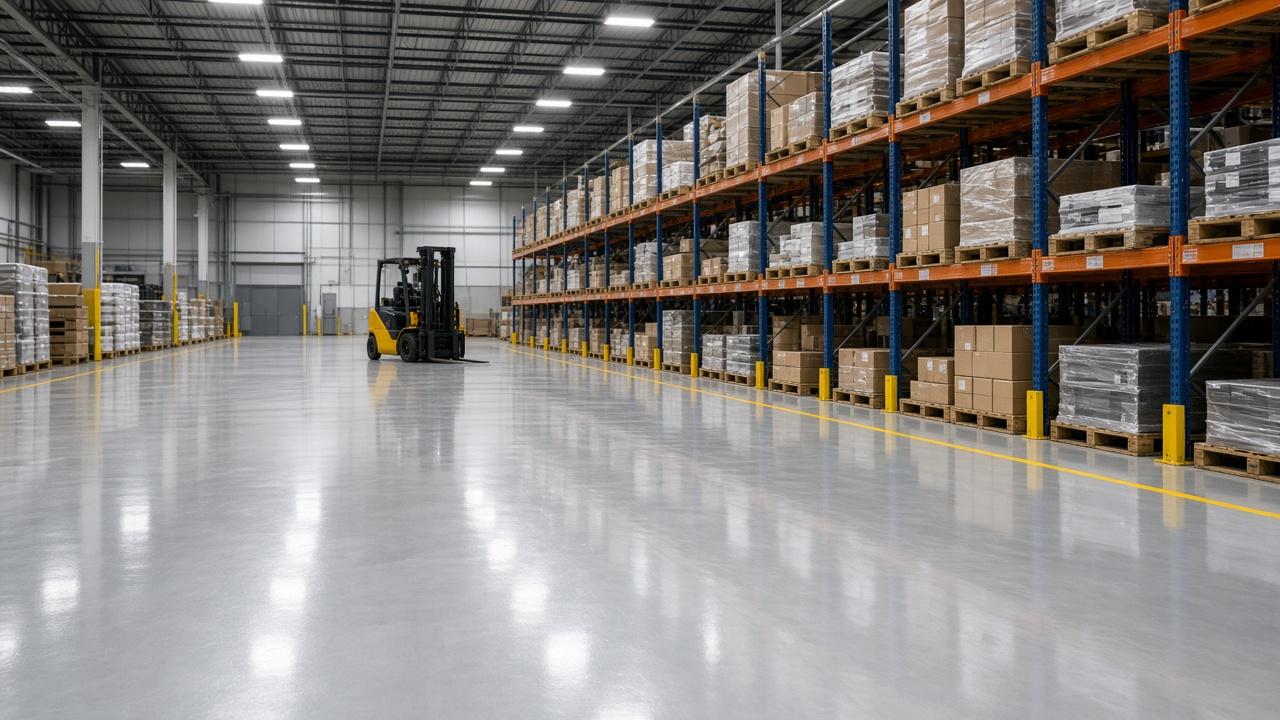
Commercial Epoxy Flooring Kelowna
Heavy-duty epoxy floor systems for warehouses, retail spaces, restaurants, and light industrial facilities across Kelowna and the Okanagan.
(236) 301-8111Commercial and industrial spaces demand more from their floors than any residential application. Traffic volume is higher, loads are heavier, chemical exposure is more frequent, and downtime for installation costs real money. Commercial epoxy floor systems are engineered to handle all of it — and when they're installed correctly, they last for years in even the most demanding environments.
Ready to get started?
Free on-site quote — no pressure, no obligation.
Commercial Epoxy Floor Systems: What's Available
Not all commercial epoxy systems are the same, and the right choice depends entirely on the specific use case:
**100% Solids Epoxy:** The workhorse of commercial flooring. Applied thick (typically 10–20 mils), it creates a dense, hard surface with excellent chemical resistance. Ideal for warehouses, light manufacturing, food processing, and retail.
**Broadcast Epoxy Systems:** The base coat is broadcast with aggregate (sand, aluminum oxide, or vinyl flake) to create a textured, non-slip surface. Required by code in food service areas and anywhere slip-and-fall risk is a concern.
**Polyurea / Polyaspartic Commercial Systems:** Fast-cure, high-performance coatings that can be installed during off-hours and returned to service the same day. UV-stable, highly chemical-resistant, and extremely durable. Ideal for retail environments or facilities that can't afford extended downtime.
**Self-Levelling Epoxy (SL Systems):** Poured and spread across the floor, self-levelling epoxy fills low spots and creates a perfectly smooth, seamless surface. Required in food processing, pharmaceutical, and healthcare environments where bacterial harbouring from surface irregularities is a concern.
Kelowna's Commercial Sectors We Serve
The Okanagan's commercial landscape spans a wide range of industries, each with specific flooring requirements:
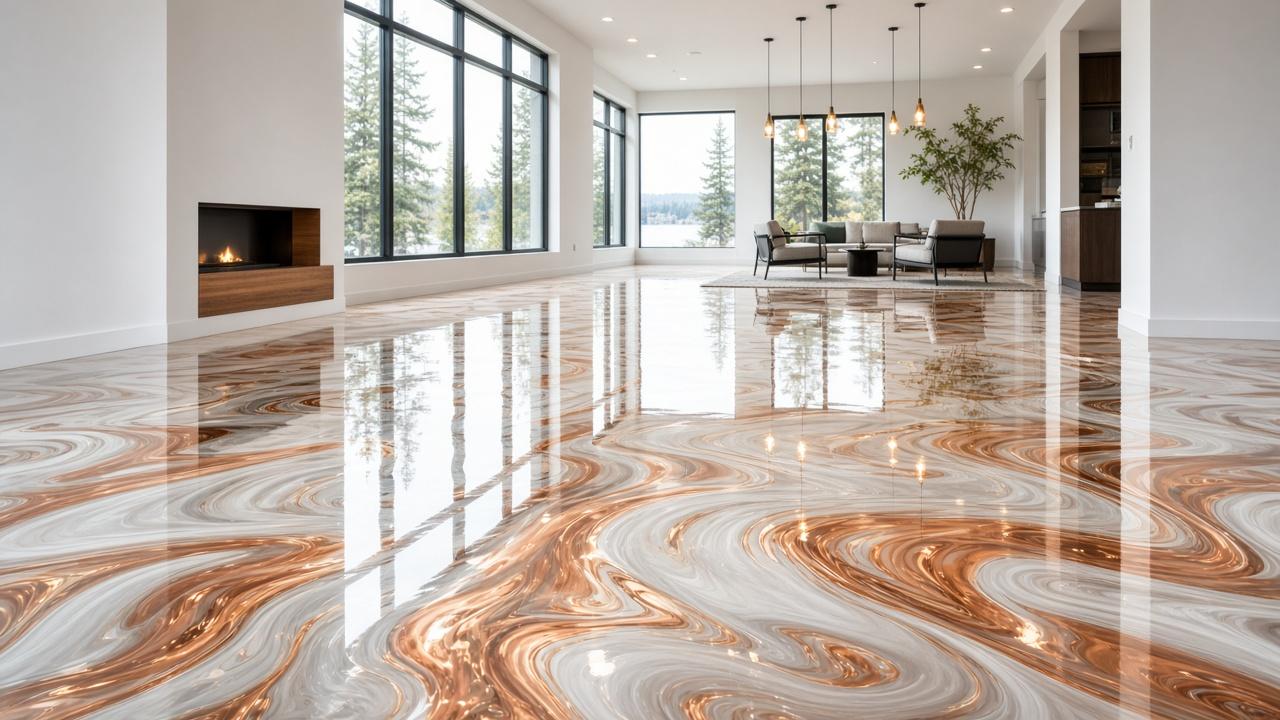
**Retail and Showrooms:** High-gloss commercial epoxy or polyaspartic creates a premium presentation surface. Metallic epoxy is increasingly popular in upscale showrooms and automotive dealers.
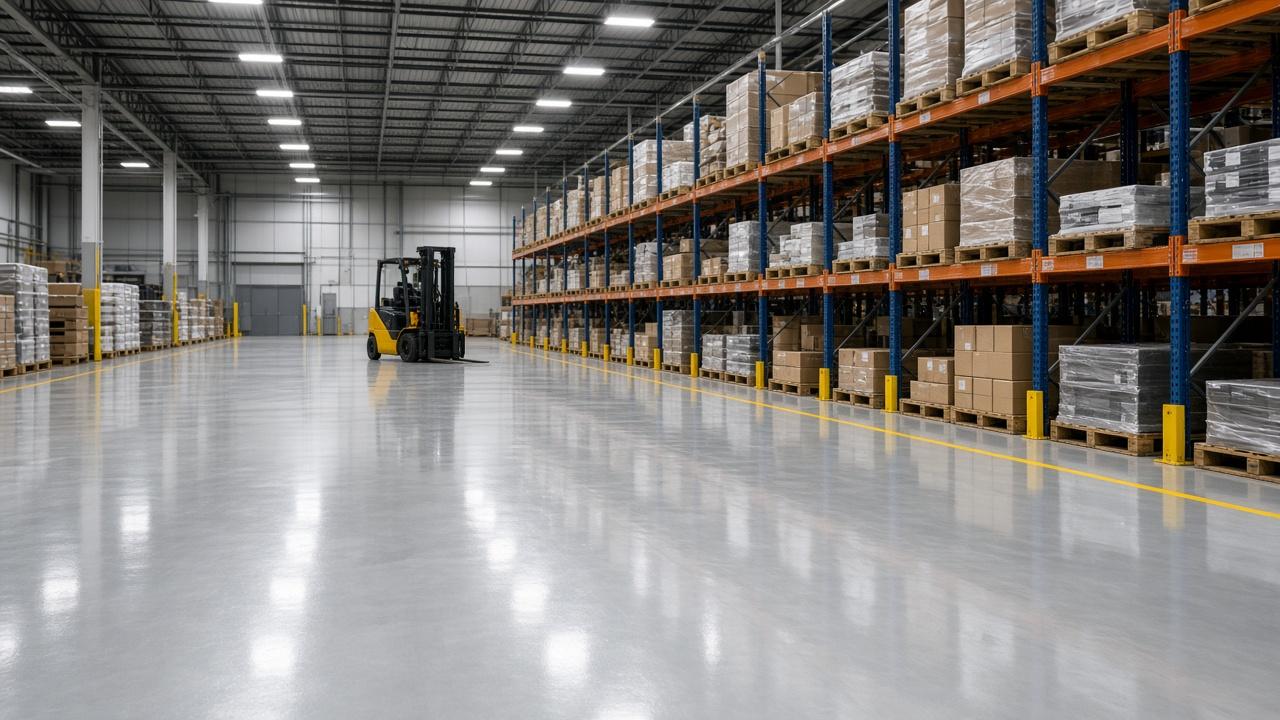
**Warehouses and Distribution:** Heavy forklift traffic, pallet-jack loads, and racking systems require a thick, well-bonded epoxy with aggregate for slip resistance. Safety line marking in yellow or white is standard.
**Food and Beverage:** Wineries, cideries, breweries, and commercial kitchens need seamless, CFIA-compliant floors that resist acids (wine spills, cleaning chemicals) and are easy to sanitize. Anti-slip texture is required in wet areas.
**Auto Service:** Oil, brake fluid, coolant, and transmission fluid are daily realities in auto shops. A chemical-resistant epoxy with polyaspartic topcoat handles all of it.
**Healthcare and Veterinary:** Seamless, easy-clean floors that don't harbour pathogens. Typically a smooth self-levelling system with a urethane or polyaspartic topcoat.
Minimising Business Downtime During Installation
The biggest concern for most commercial clients is not the floor itself — it's how long they're out of commission during installation. We work around your schedule:
- **Weekend or overnight installs** for businesses that can't shut down during operating hours - **Phased installs** — we coat half the floor, you move operations to the coated side, then we do the other half - **Polyaspartic fast-cure systems** that return the floor to service in hours rather than days
Call us and describe your operating constraints. We've installed commercial floors in active facilities before and can usually find a sequencing plan that minimises your disruption.
Commercial Floor Prep: Higher Stakes, Same Discipline
The principles of concrete preparation don't change at commercial scale — they just become more critical because the cost of a failure is higher. We use ride-on diamond grinding equipment for large commercial slabs, shot-blasting for surfaces that need heavy contamination removal or very high CSP, and hand-grinders for tight areas around equipment pads and columns.
For occupied facilities with equipment that can't be moved, we work around it. For large open slabs, ride-on equipment dramatically speeds up the prep phase without compromising quality.
Moisture testing is mandatory on all commercial jobs. Vapour pressure problems under a large commercial epoxy floor are expensive failures — we test, document, and use appropriate primers before any coating goes down.
Safety Line Marking and Special Features
Commercial epoxy floors often need more than just a coating. We also install:
**Safety line marking:** Forklift lanes, pedestrian walkways, loading zones, and hazard areas marked in yellow, white, or red epoxy or polyaspartic. Crisp lines that stay visible for years.
**Anti-slip aggregate:** Aluminum oxide or silica sand broadcast into topcoats for areas with water, oil, or chemical exposure.
**Cove base:** A 4" epoxy cove base where the floor meets the wall creates a seamless, cleanable transition required in food service and healthcare environments.
**Chemical resistance upgrades:** For severe chemical exposure (acid wash areas, chemical storage), we use urethane mortar systems or chemical-resistant epoxy formulations.
Commercial Floors — Common Questions
How thick does a commercial epoxy floor need to be?+
How long does a commercial epoxy floor last?+
Can you apply epoxy to a warehouse floor with oil contamination?+
More Epoxy Flooring Services in Kelowna
Ready for a Floor That Actually Impresses?
Get a free, no-pressure quote for your Kelowna property. We measure, assess the slab, and give you a straight answer.