Concrete Grinding & Floor Prep Kelowna
Proper surface preparation is the foundation of every long-lasting floor coating. We grind, shot-blast, and profile Kelowna concrete slabs to the CSP required for each system.
(236) 301-8111Concrete floor grinding and surface preparation is the least glamorous part of epoxy flooring — and the most important. More floor coating failures in Kelowna come from inadequate surface prep than from coating quality, product selection, or installation technique. If the concrete isn't properly profiled, contamination-free, and moisture-stable before the coating goes down, the best epoxy in the world will eventually fail.
Ready to get started?
Free on-site quote — no pressure, no obligation.
What Is Concrete Surface Profile (CSP) and Why It Matters
Concrete Surface Profile is a standardised scale developed by the International Concrete Repair Institute (ICRI) that measures the texture and roughness of a prepared concrete surface. CSP runs from 1 (nearly smooth, like sanded concrete) to 9 (very heavily scarified surface). Different coating systems require different profiles:
- Thin coatings and sealers: CSP 1–2 - Standard epoxy coatings (10–20 mil): CSP 2–3 - Thick-build and mortar systems: CSP 3–5
Why does this matter? Coatings bond mechanically — the liquid epoxy flows into the peaks and valleys of the surface profile and locks in as it cures. A surface that's too smooth doesn't give the coating enough surface area or mechanical interlocking to hold. Acid etching (which some contractors still use) creates an inconsistent, shallow profile that's far less effective than diamond grinding. Every job we do uses diamond tooling to achieve the correct, consistent profile across the entire slab.
Our Grinding Equipment and Process
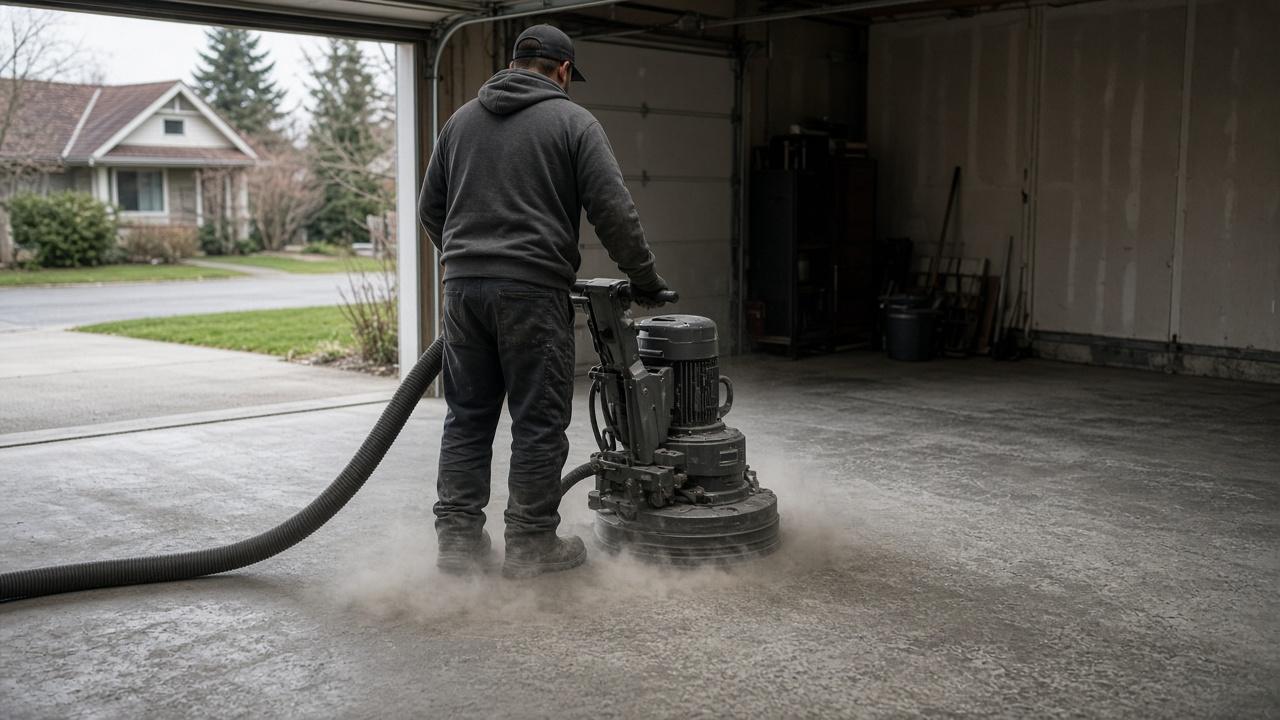
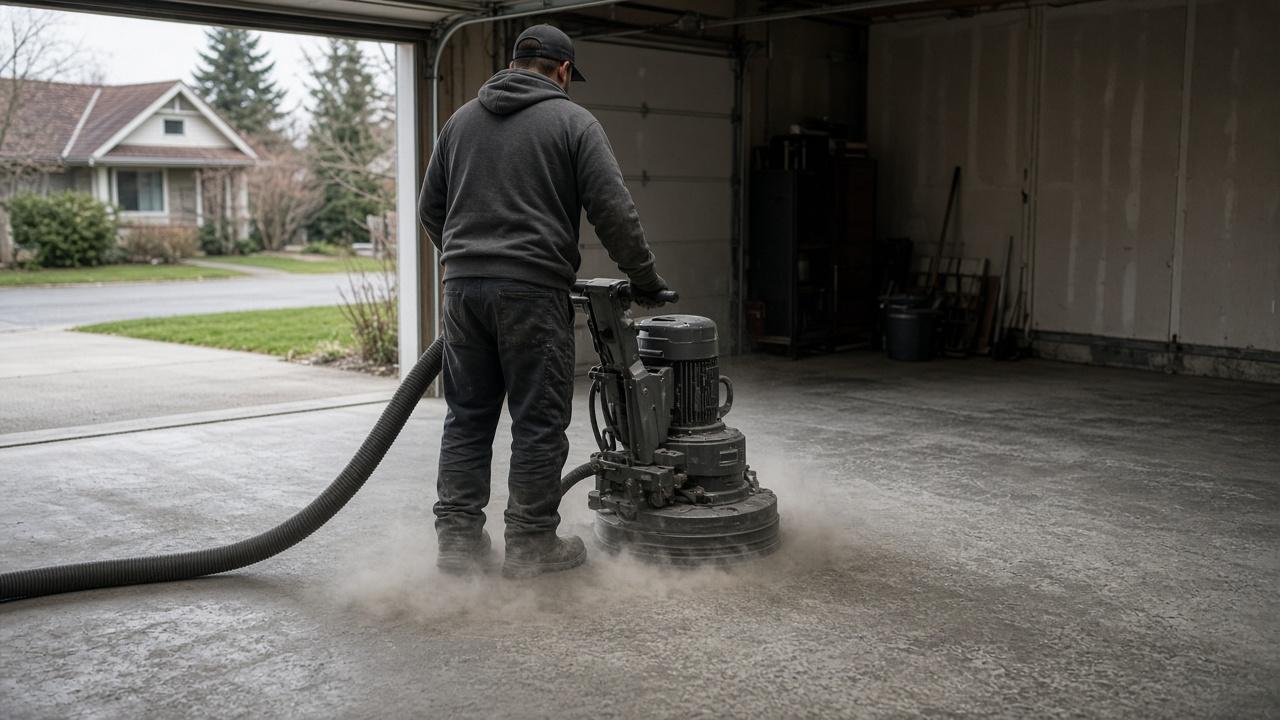
We use planetary-head diamond grinders for the majority of our residential and commercial work. Planetary grinders use counter-rotating discs to achieve even coverage without the swirl marks left by single-disc machines. Diamond tooling is selected based on the concrete hardness and the profile required — softer concrete in older Okanagan homes grinds differently than modern hard concrete.
For large commercial slabs, we use ride-on grinding equipment that covers significantly more square footage per day. For tight areas — around posts, along walls, in corners — we use hand-held angle grinders and specialty edging tools to ensure complete coverage. A slab with well-ground centres and un-ground edges is a slab waiting to delaminate at the perimeter.
All of our grinding equipment is attached to industrial dust extraction systems. We contain silica dust at the source rather than letting it fill the space — both for our crew's health and for your property.
Crack Repair and Surface Defect Treatment
Crack repair is part of the prep process, not a separate service. We address:
**Hairline cracks:** Filled with a low-viscosity epoxy crack filler that penetrates and bonds to the crack walls. Ground flush after cure.
**Wider cracks (>1/8"):** Routed to a consistent width, filled with polyurea or epoxy crack filler, and ground flush. Polyurea is preferred for cracks that may move slightly — it's flexible while cured.
**Spalling and surface voids:** High spots ground down, low spots and pitting filled with epoxy skim coat or fast-setting concrete repair mortar and ground flush.
**Control joints:** Left in place (they're there to control cracking — covering them traps movement in the slab). We bridge them with polyurea flexible filler and reinforce with fibreglass tape embedded in the base coat.
We document crack locations and treatment as part of the job record. This matters because clients sometimes see cracks re-appear through a finished coating — when this happens after our repair, it's slab movement, not a coating failure.
Moisture Testing: The Step That Can't Be Skipped
Concrete breathes. Moisture moves through concrete by capillary action and as vapour, and the pressure of this movement can be strong enough to push an epoxy coating off the slab from below. This is called osmotic blistering, and it's one of the most common causes of epoxy floor failures.
We test all slabs for moisture before coating using in-slab relative humidity probes drilled to 40% slab depth (ASTM F2170). Industry standards call for no more than 75–80% relative humidity in the slab before standard epoxy application. If we find higher levels, we either use a moisture-tolerant primer specifically designed for high-vapour conditions, or we discuss the moisture source with you and determine whether it needs to be addressed.
Slabs below grade (basements), slabs without vapour barriers, and older construction without modern sub-slab drainage are the highest-risk cases. We always test before we coat.
Shot-Blasting vs. Diamond Grinding: When Each Is Used
Shot-blasting uses high-velocity steel shot propelled at the concrete surface to create a profile. It's faster than grinding on large, open commercial slabs and particularly effective at removing thin coatings, paint, and contamination. The result is a very consistent, reproducible CSP across a large area.
Diamond grinding is more versatile and controllable, handles varied concrete hardness better, and works in spaces where shot-blasting equipment can't fit. For residential garages and most commercial jobs under 5,000 sq ft, diamond grinding is our standard method.
For large commercial and industrial slabs, particularly ones with significant surface contamination, we may use shot-blasting for the primary preparation and finish with diamond grinding in areas the blasting equipment can't reach.
Floor Prep — Common Questions
Can I just pressure wash and apply epoxy instead of grinding?+
How long does concrete grinding take?+
Do you repair heaving or significantly uneven concrete?+
More Epoxy Flooring Services in Kelowna
Ready for a Floor That Actually Impresses?
Get a free, no-pressure quote for your Kelowna property. We measure, assess the slab, and give you a straight answer.