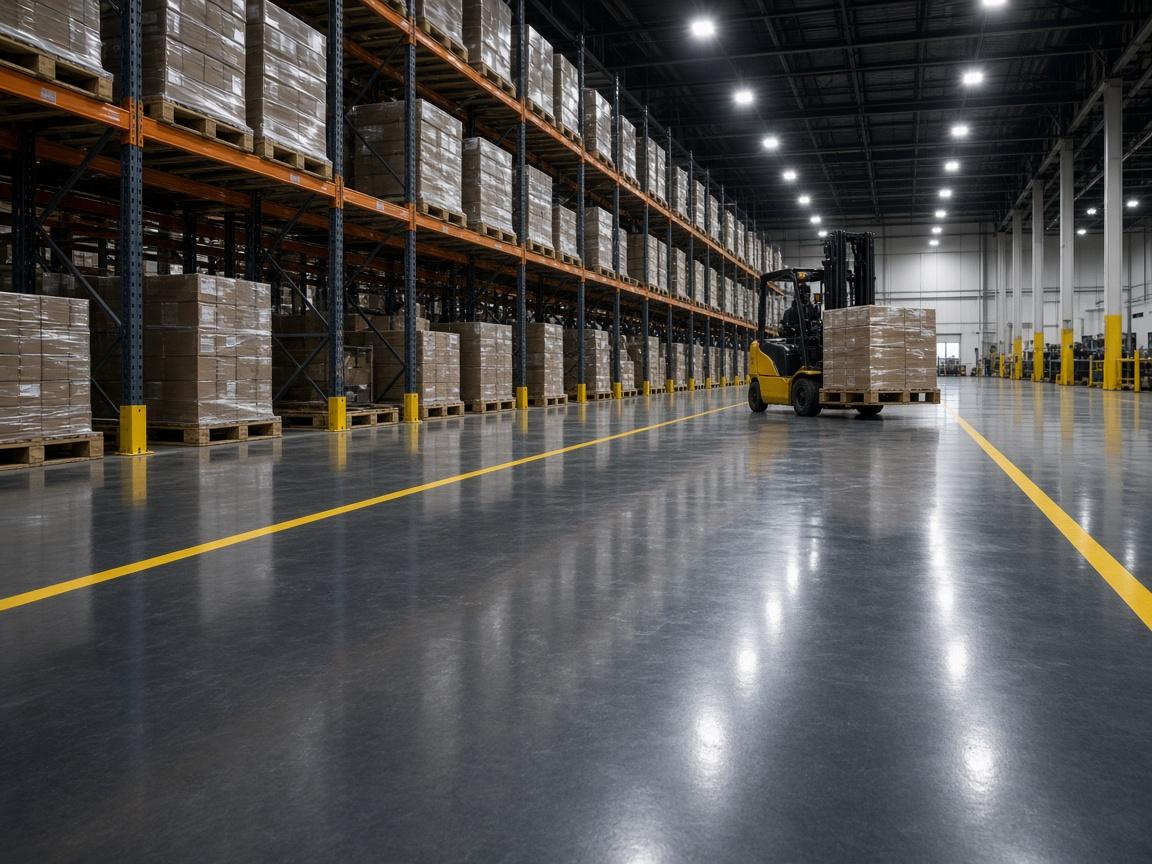
Industrial Epoxy Flooring Kelowna
Heavy-duty epoxy floor systems for manufacturing, processing, fleet maintenance, and high-traffic industrial facilities across the Okanagan. Forklift-rated, chemical-resistant, built to last.
(236) 301-8111Industrial facilities put floors through punishment that residential and light commercial applications never see — forklift traffic, pallet-jack loads, heavy machinery vibration, thermal cycling from process equipment, and chemical exposure from oils, fuels, cleaning agents, and process chemicals. Standard residential epoxy systems aren't built for this. Industrial epoxy flooring uses higher-build systems, tougher formulations, and surface preparation techniques calibrated for concrete that's taken decades of heavy use.
Ready to get started?
Free on-site quote — no pressure, no obligation.
What Makes Industrial Epoxy Different from Commercial Epoxy
The distinction between commercial and industrial epoxy isn't just marketing — it reflects genuine differences in system thickness, material chemistry, and surface preparation requirements.
Commercial epoxy systems for retail and light commercial spaces typically run 10–20 mils total thickness. Industrial systems start at 20 mils and commonly run 40–125 mils for heavy-duty applications. The thicker the system, the more it can absorb impact, distribute point loads from forklift wheels and equipment feet, and resist the abrasion of heavy traffic.
Industrial formulations also differ chemically. Where commercial systems use standard bisphenol-A epoxy, industrial applications often call for:
**Cycloaliphatic epoxy:** Better UV resistance and colour stability under process lighting conditions.
**Novolac epoxy:** Extremely high chemical resistance for environments with regular exposure to solvents, acids, or caustics. Required in chemical processing, brewing, food processing with acid-clean sanitation, and automotive service with brake fluid and solvent exposure.
**Urethane mortar:** A thick-build system that handles thermal shock (direct steam, hot water, temperature fluctuations from process equipment) better than standard epoxy. Required in commercial kitchens, breweries, and food processing facilities.
Industrial Floor Systems for Kelowna Facilities
The Okanagan's industrial base spans a variety of sectors, each with specific flooring demands:
**Fleet Maintenance and Auto Service:** Oil, brake fluid, coolant, hydraulic fluid, and transmission fluid are daily realities. A novolac epoxy or high-chemical-resistance polyaspartic system with anti-slip aggregate handles all of it. Drain channels and floor slopes for wash-down need to be planned before coating.
**Food and Beverage Processing:** Kelowna's wine, cider, and food processing sector needs CFIA-compliant seamless floors that resist the organic acids in wine and juice, handle regular hot-water and chemical sanitizing, and meet health authority requirements for food-safe surfaces. Urethane mortar or epoxy cove base at wall junctions eliminates bacterial harbouring points.
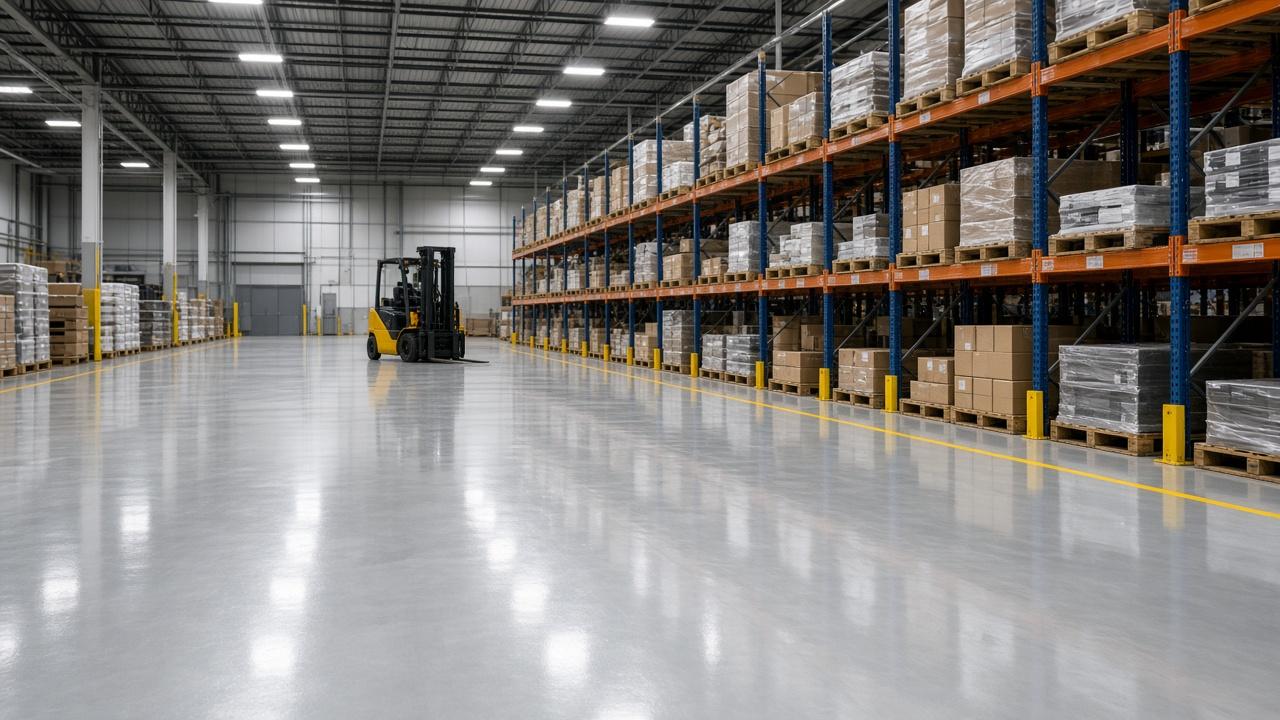
**Warehouses and Distribution:** Forklift lanes take the hardest beating in any warehouse — the combination of point load from forklift wheels and constant turning motion abrades floors aggressively. We spec thick-build systems with high-hardness aggregates for forklift lanes and identify which areas of the floor need the heaviest system.
**Manufacturing:** Machinery vibration, oil contamination, and chemical cleaning cycles in manufacturing environments require systems that can be repaired in sections and maintained over time without full replacement.
Surface Preparation at Industrial Scale
Industrial surface preparation is more aggressive than residential prep for two reasons: industrial slabs have typically accumulated more contamination (oil, grease, process chemicals) that penetrates deep into the concrete, and the systems going down are thicker and heavier, requiring a more aggressive profile to develop adequate adhesion.
For heavily contaminated industrial slabs, our approach:
1. **Oil and contamination assessment:** We core-sample the slab and assess how deep oil contamination has penetrated. Shallow contamination responds to degreasing and diamond grinding. Deep contamination may require thermal treatment (propane torching to volatilize subsurface oil) followed by grinding.
2. **Shot-blasting for large areas:** For open industrial floors over 3,000 sq ft, shot-blasting is more efficient than diamond grinding and produces a very consistent, reproducible CSP across the entire surface. We follow shot-blasting with diamond grinding in areas around equipment pads, columns, and walls.
3. **Aggressive diamond grinding for contaminated areas:** Metal-bonded diamond tooling at coarser grits removes contamination and creates a CSP 3–4 profile appropriate for thick-build industrial systems.
4. **Crack and joint treatment at industrial scale:** Industrial slabs crack — often significantly. We repair structural cracks with epoxy injection, fill surface cracks with polyurea, and treat expansion joints with flexible fillers and reinforcing tape or metal edge protection.
Minimising Industrial Downtime During Installation
For a manufacturing or distribution facility, the floor is the foundation of operations — literally. Taking it out of service for installation is a real cost. We approach industrial floor installations with a detailed sequencing plan:
**Phased installation:** We divide the floor into zones, coating one zone at a time while operations continue in adjacent areas. The complexity depends on your facility layout, but most industrial floors can be phased without a full shutdown.
**After-hours and weekend scheduling:** For facilities that run day shifts only, we work evenings and weekends to keep pace with a production schedule.
**Fast-cure systems:** Polyaspartic and polyurea systems cure dramatically faster than standard epoxy — often returning to vehicle traffic in 4–8 hours rather than 24–72 hours. For facilities where schedule is tight, a polyaspartic industrial system reduces the out-of-service window significantly.
**Temporary marking:** During phased installs, we use temporary caution tape and barriers to protect fresh coating in adjacent zones from forklift and foot traffic.
Safety Markings and Industrial Floor Features
Industrial floors do more work than just protecting the concrete beneath. Properly designed industrial floor systems incorporate:
**Traffic demarcation:** Forklift lanes, pedestrian walkways, loading zones, and staging areas marked in epoxy or polyaspartic in yellow, white, orange, or red. Crisp, durable lines that stay legible for years under traffic.
**Hazard identification:** Machine safety perimeters, electrical panel zones, fire equipment locations, and emergency exit paths marked and maintained in code-compliant colours.
**Anti-slip zoning:** Different areas of an industrial floor need different slip resistance. Dry traffic areas can use moderate texture; wet or oil-exposed areas need aggressive anti-slip aggregate broadcast into the topcoat.
**Floor drains and slopes:** Oil/water separator drains in auto service facilities, and controlled slopes in wash-down areas, need to be coordinated with the coating system. We coat drain surrounds and sloped areas as part of the overall system.
**Cove base:** In food service, pharmaceutical, and healthcare industrial settings, a 4" radius epoxy cove base where the floor meets the wall creates a seamless, cleanable transition that meets regulatory requirements.
Industrial Floors — Common Questions
How thick does an industrial epoxy floor need to be?+
Can you coat an industrial floor that's heavily contaminated with oil?+
How long does an industrial epoxy floor last before it needs to be recoated?+
More Epoxy Flooring Services in Kelowna
Ready for a Floor That Actually Impresses?
Get a free, no-pressure quote for your Kelowna property. We measure, assess the slab, and give you a straight answer.